20 Funny Twitter Thread About Maps That Turned Into A Roast

Mar 29, 2026 02:00 PM EDT
A funny twitter thread about maps where a guy gets roasted for not understanding how maps make countries look different sizes.
google discoverFollow us on Google Discover

This funny twitter thread about maps is what happens when someone asks an innocent question and the internet responds with both a lecture and a roast, at the same time. If you’re into Mercator projection drama, map projection facts, and geography jokes that make you feel smarter and pettier in one scroll, you’re going to love this.
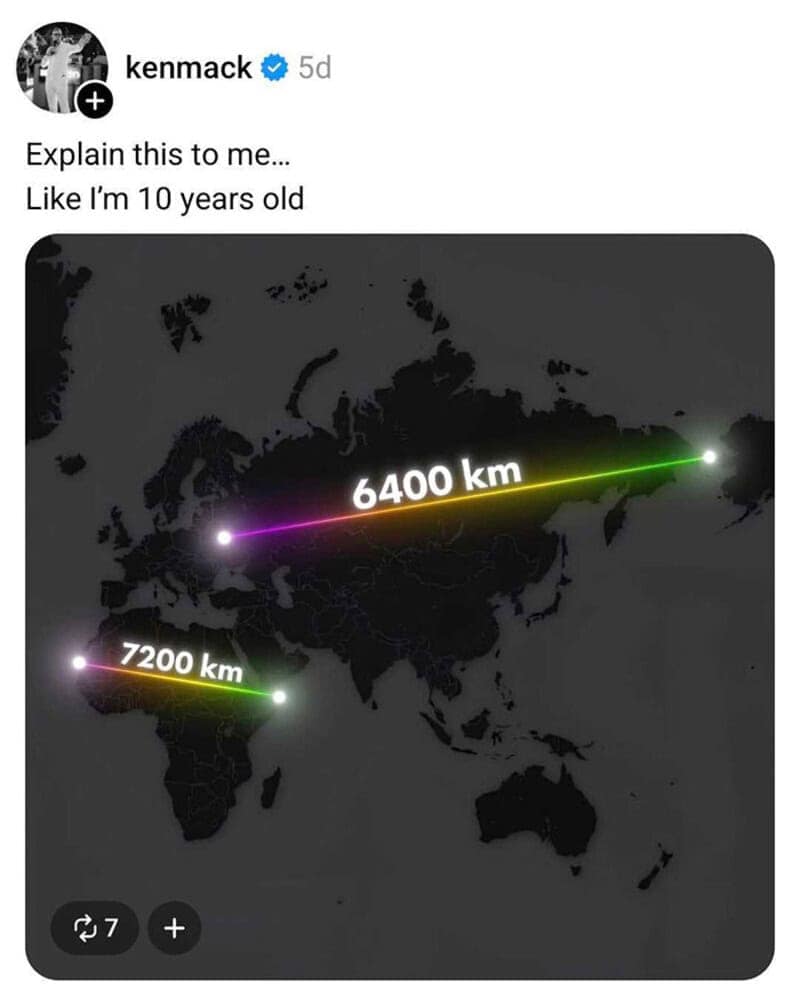
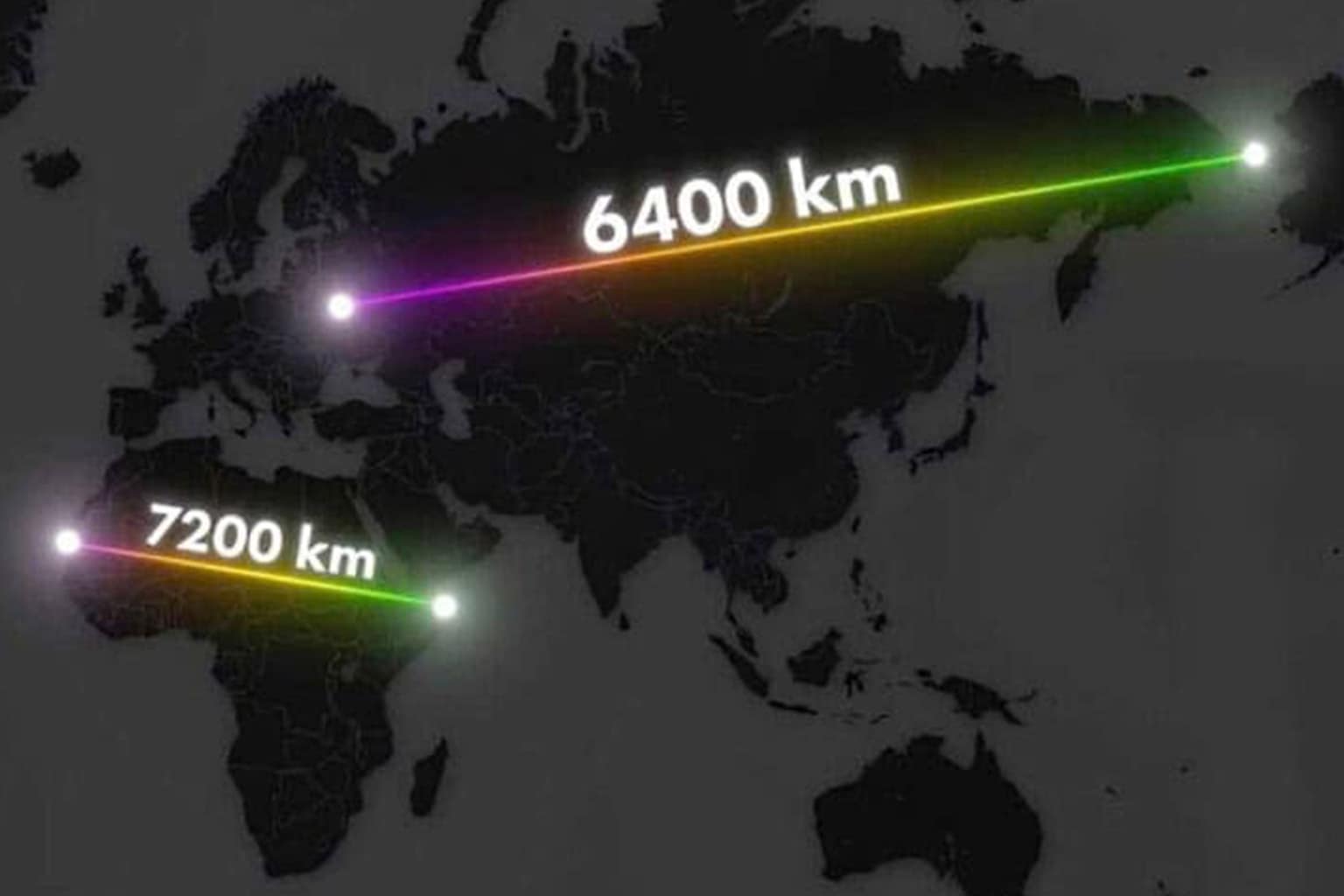
The start of a funny twitter thread about maps from user @kenmack. The post features a dark world map where a line representing 6400km across Russia looks significantly longer than a 7200km line across Africa, prompting the question: "Explain this to me... Like I'm 10 years old."
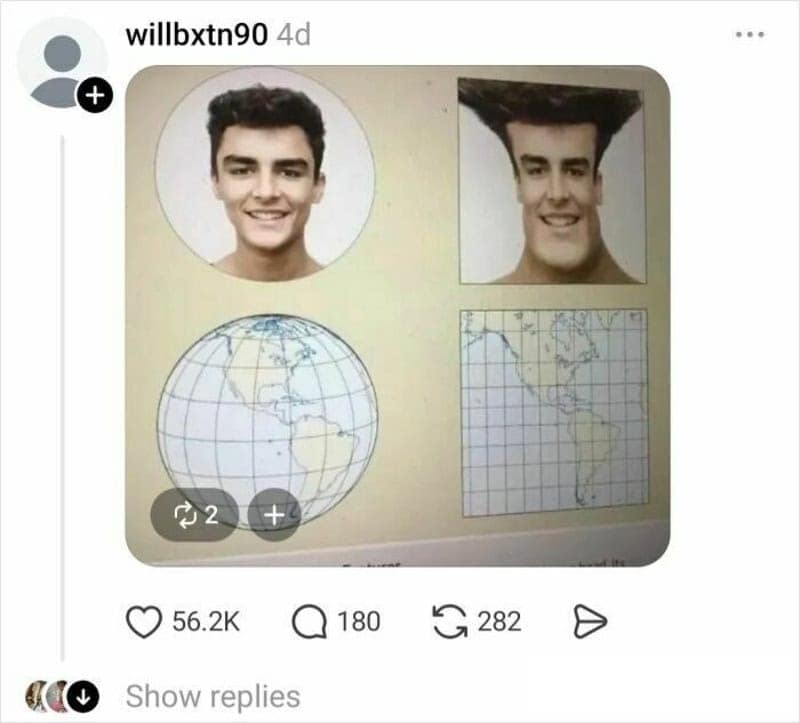
A reply in the funny twitter thread about maps from @willbxtn90 using a face distortion analogy. It shows a normal head in a circle contrasted with a hilariously stretched, wide-jawed face in a square to illustrate how a spherical Earth gets warped when forced into a flat rectangular Mercator projection.
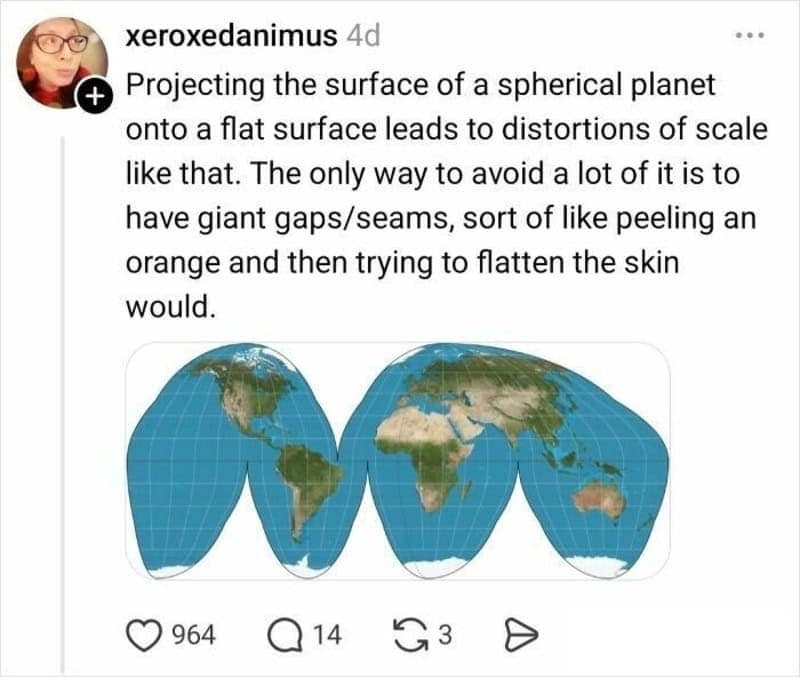
A scientific contribution to the funny twitter thread about maps from @xeroxedanimus. The post explains that flattening a sphere leads to scale distortions, showing an "Interrupted Homolosine" world map that looks like a flattened orange peel to maintain accurate landmass proportions.
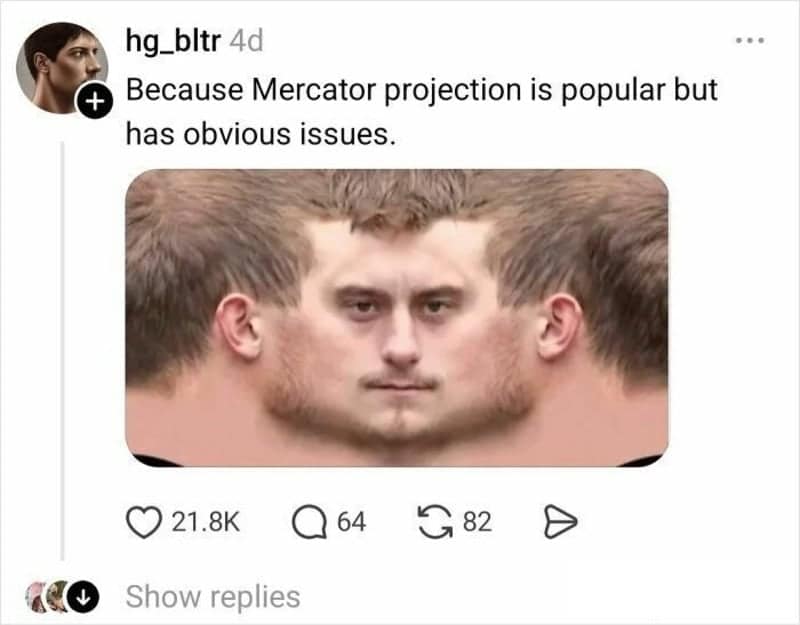
A visually cursed entry in the funny twitter thread about maps from @hg_bltr. It shows a man's face flattened out as a 2D skin texture—nose in the middle, ears on the far edges—to demonstrate the "obvious issues" with the popular Mercator projection.
A humorous, nonsensical explanation from @cricket_47_hub in the funny twitter thread about maps. The text-only post jokingly applies the logic of thermal expansion to geography: "Russia cold, area shrink. Africa hot, area expand."
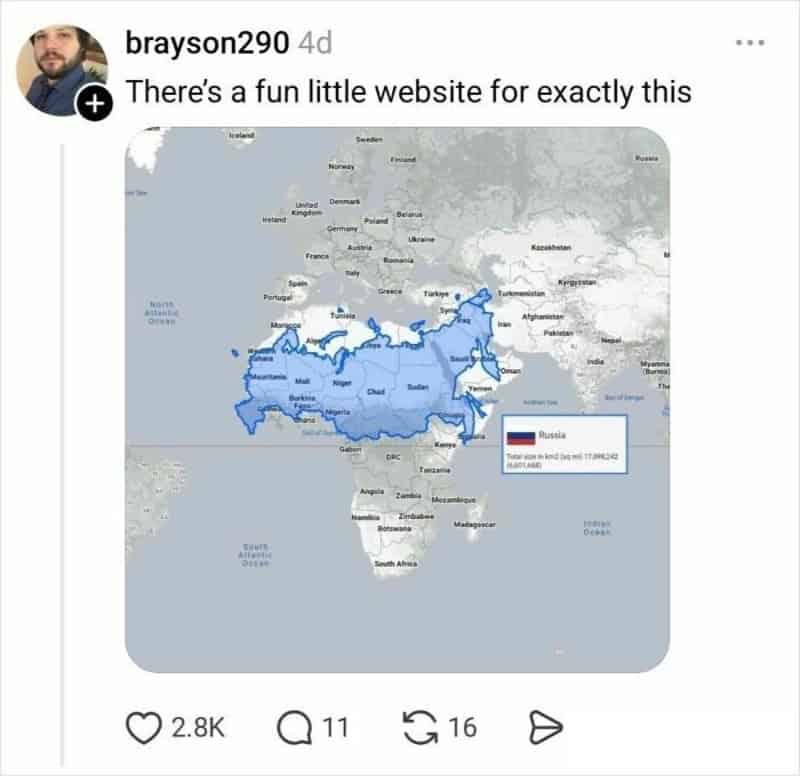
A helpful reply from @brayson290 in the funny twitter thread about maps featuring a screenshot from "The True Size" website. It visually proves Mercator distortion by dragging a blue outline of Russia over Africa, revealing that the massive country is actually much smaller than it appears at the top of a standard map.
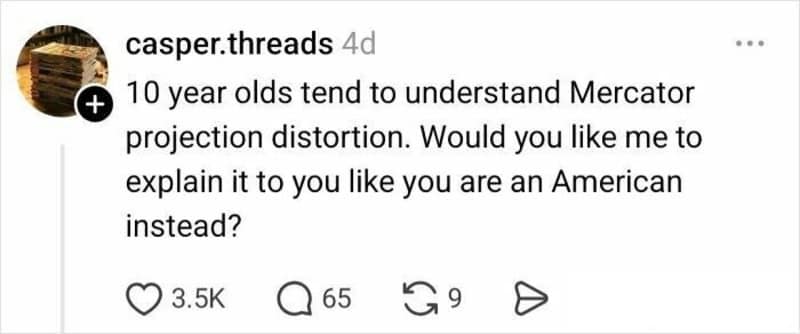
A snarky contribution to the funny twitter thread about maps from @casper.threads. The post mocks the original poster's intelligence by suggesting that since 10-year-olds understand map distortion, they should instead offer an explanation for "an American."
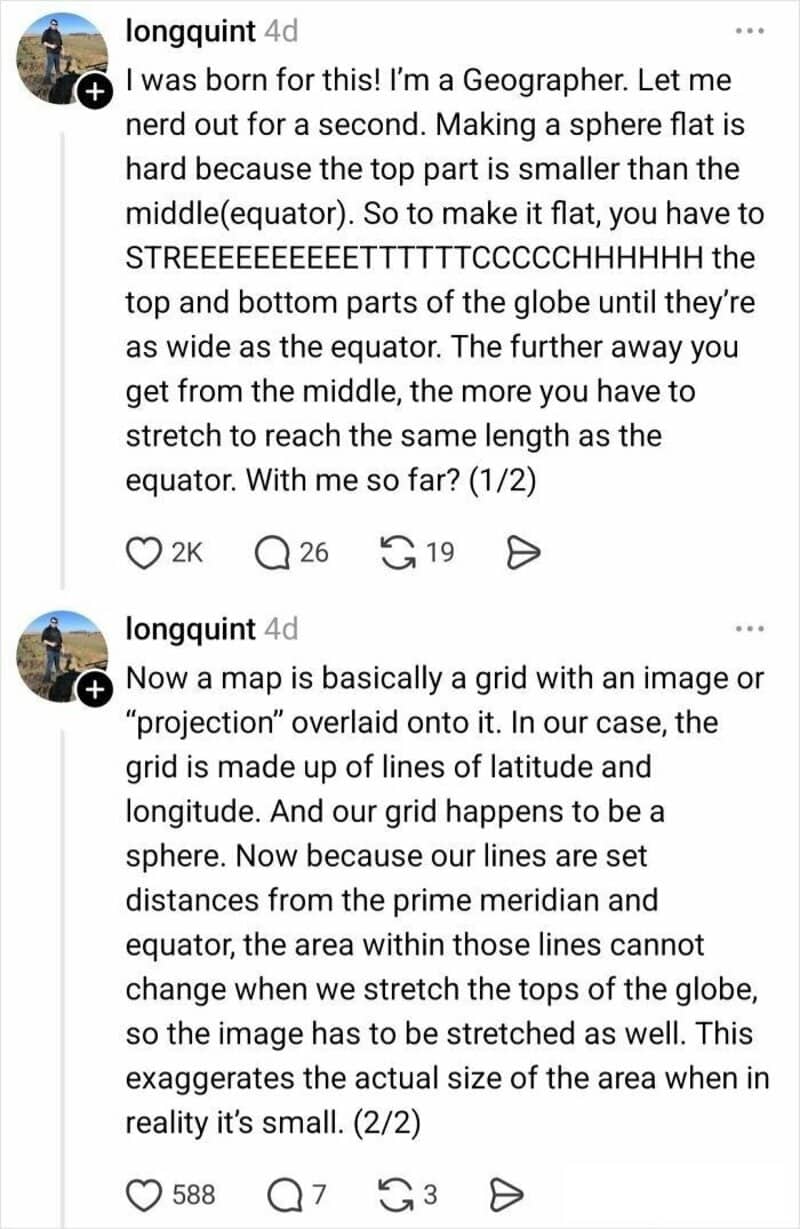
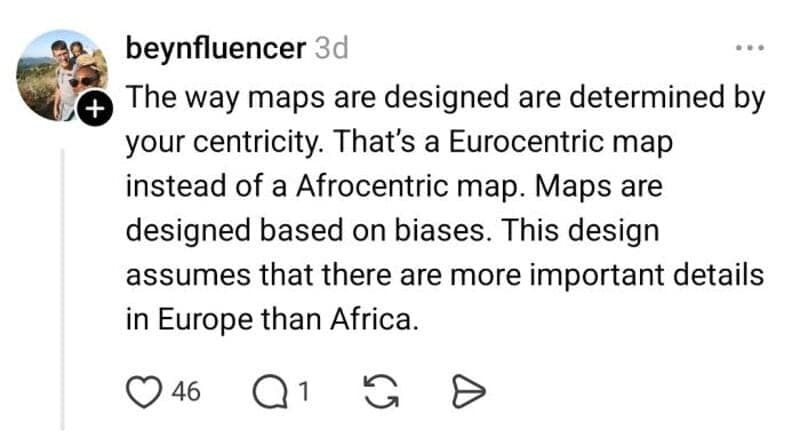
two-part educational reply from geographer @longquint in the funny twitter thread about maps. The text explains that making a sphere flat requires "STREEEEEEEETTTTTTCCCCCHHHHH"-ing the poles until they are as wide as the equator, which naturally exaggerates the size of Northern landmasses.
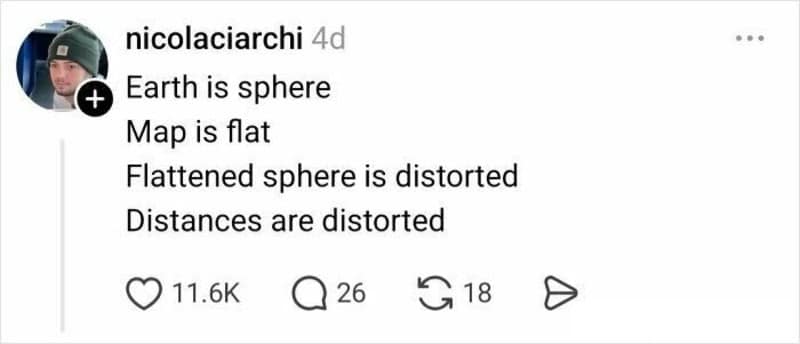
A concise summary from @nicolaciarchi in the funny twitter thread about maps. The post simplifies the entire geographical debate into four simple lines: "Earth is sphere. Map is flat. Flattened sphere is distorted. Distances are distorted."
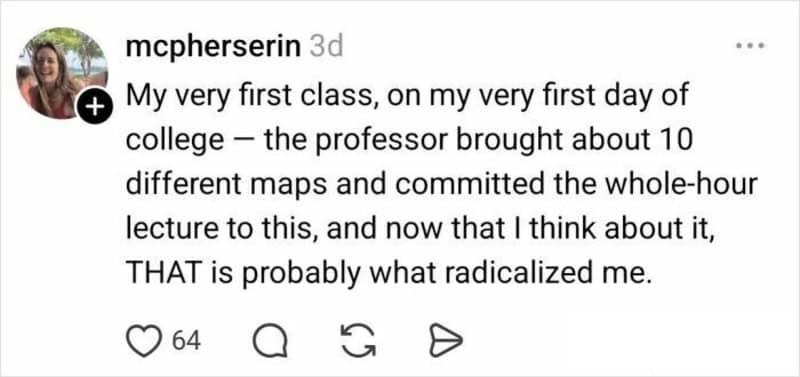
A final anecdote in the funny twitter thread about maps from @mcpherserin. She claims she was "radicalized" on her first day of college when a professor dedicated an entire hour to showing 10 different, conflicting world maps to prove they are all "liars."
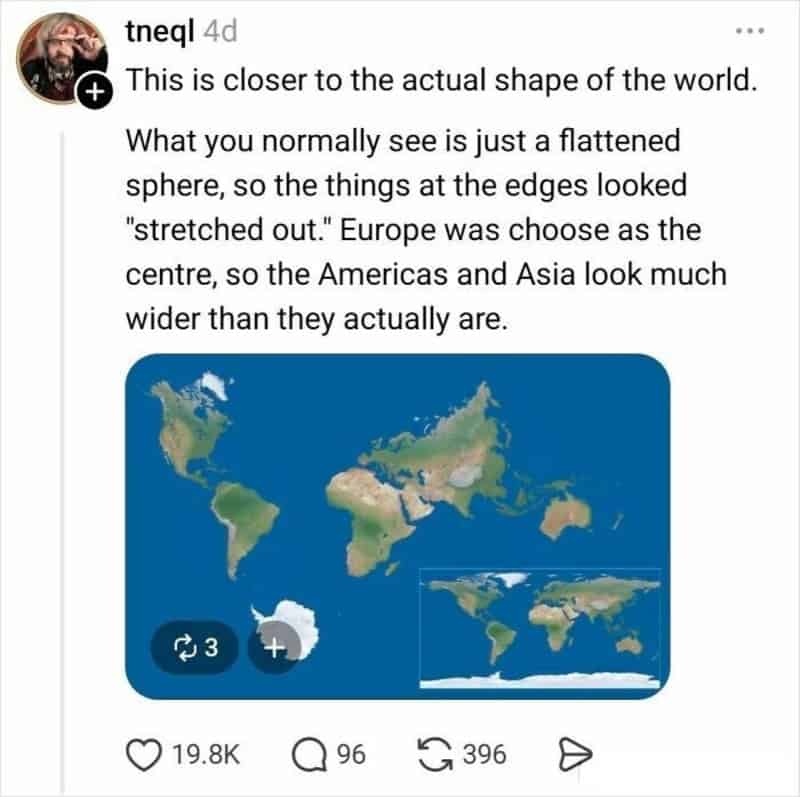
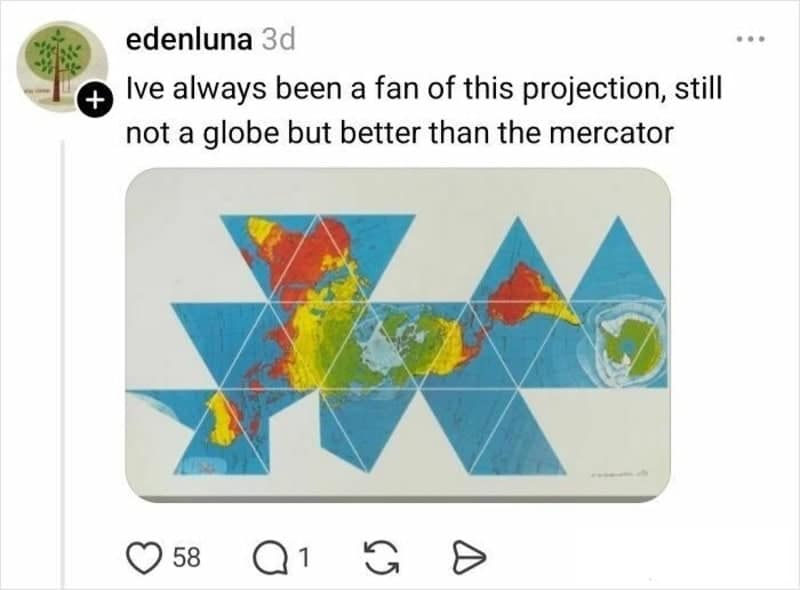
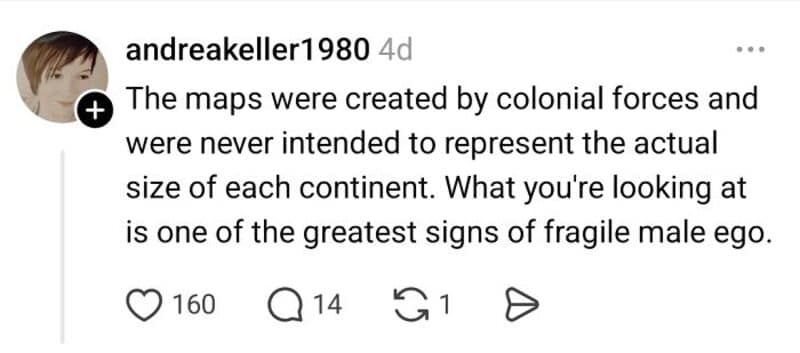
An educational reply in the funny twitter thread about maps from @tneql. The post shares a Gall-Peters projection map—which looks "squashed" compared to standard maps—explaining that it is closer to the world's actual shape because it corrects the "stretched out" distortion caused by placing Europe at the center.
A pop-culture reference from @theericajoy noting that "the west wing prepared me for this moment." The tweet refers to a famous episode of The West Wing where the "Organization of Cartographers for Social Equality" explains why the Mercator projection is biased.
A text-heavy explanation from @thereelrandom_ in the funny twitter thread about maps. He uses the "orange peel" analogy to explain that because a sphere cannot be laid flat without gaps, cartographers "fill in the gaps," which makes landmasses at the poles appear significantly larger than they are.
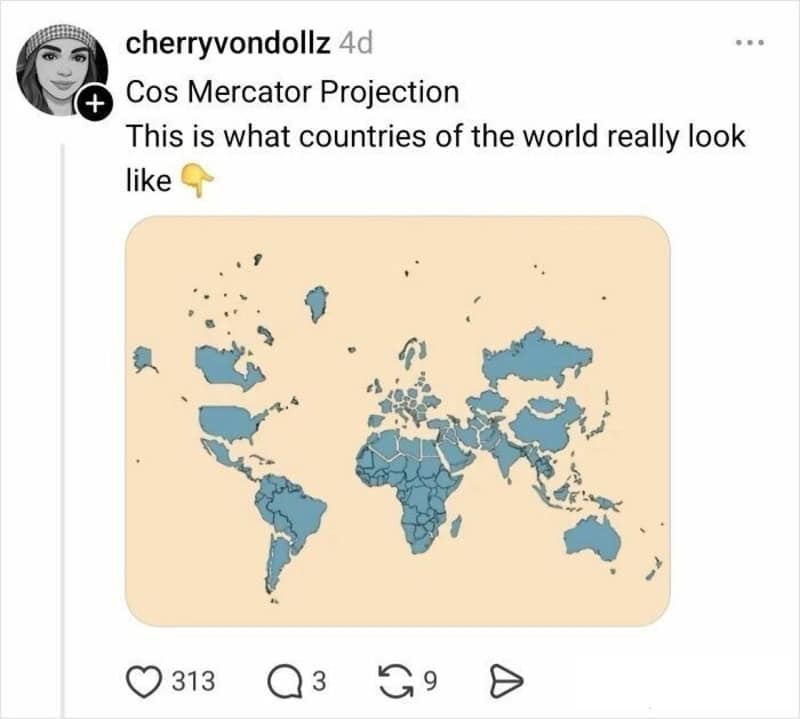
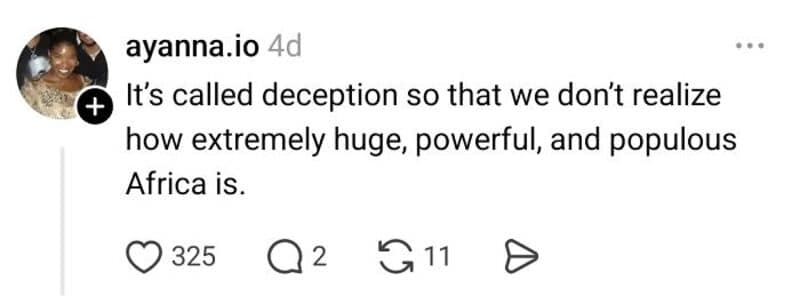
A visual guide from @cherryvondollz titled "This is what countries of the world really look like." The map shows landmasses separated and sized according to their actual square mileage, revealing a massive Africa and a drastically smaller Greenland and Europe.
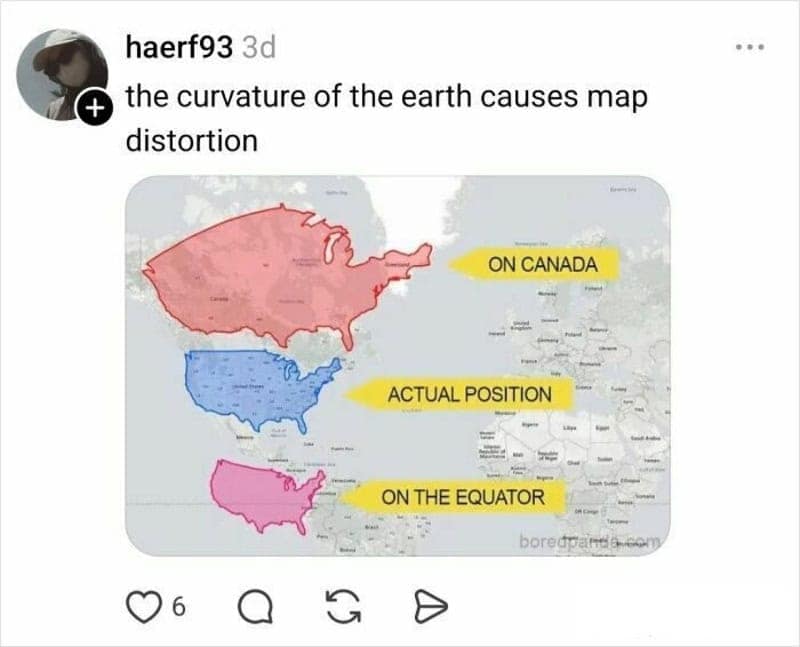
A graphic demonstration from @haerf93 showing how the "curvature of the earth causes map distortion." It shows the outline of the United States in three sizes: its actual size, a massive version when dragged over Canada, and a tiny version when placed on the equator.
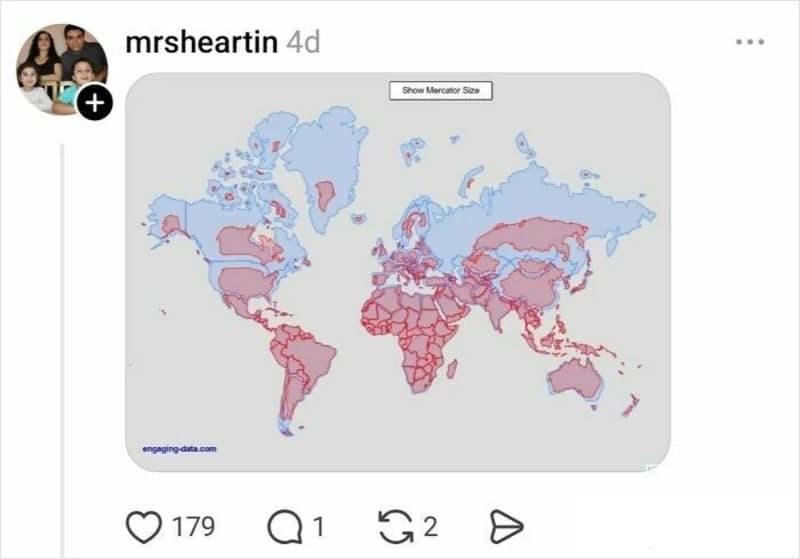
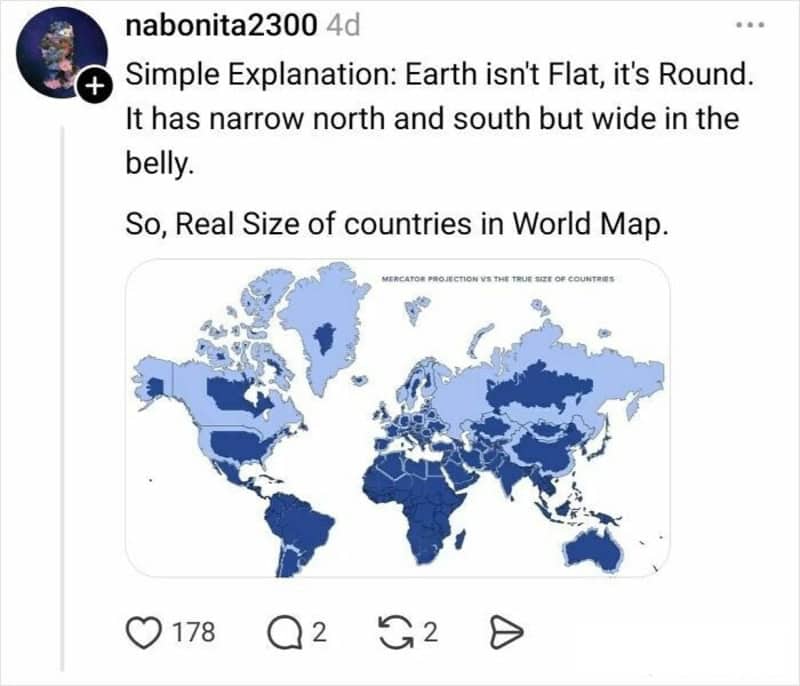
A comprehensive map overlay from @mrsheartin comparing "Mercator Size" (light blue) with "True Size" (red). The visual shows how continents like Africa and South America are nearly identical to their map representation, while Russia, Canada, and Greenland are astronomically smaller in reality.
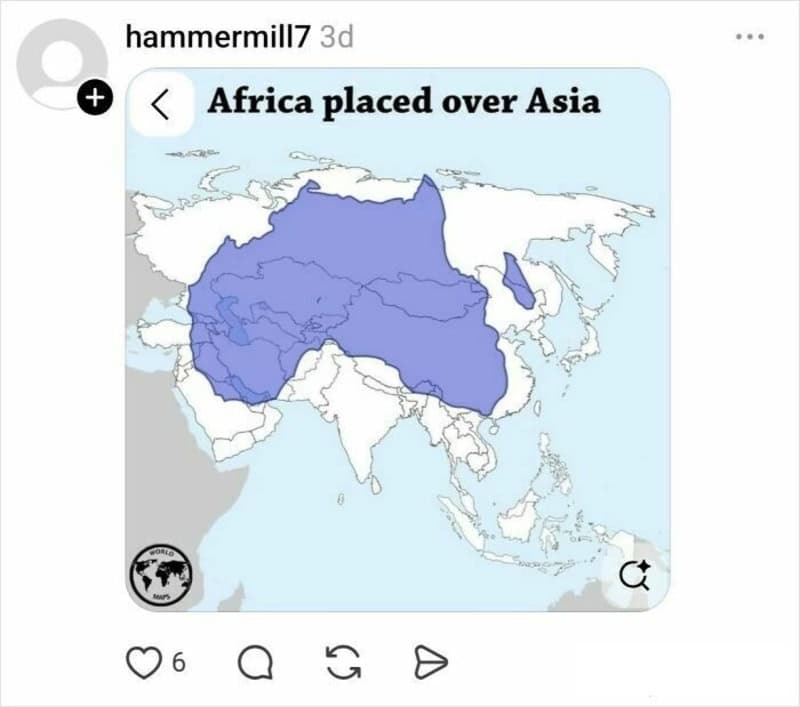
A striking size comparison from @hammermill7 in the funny twitter thread about maps. The image shows the blue outline of the entire continent of Africa placed directly over Asia, illustrating that Africa is nearly as wide as the world's largest continent.
Another "West Wing" mention from @smilingchaos, who claims that "your maps have been lying to you" and that she is "still processing" the fact that the maps she grew up with are mathematically incorrect.
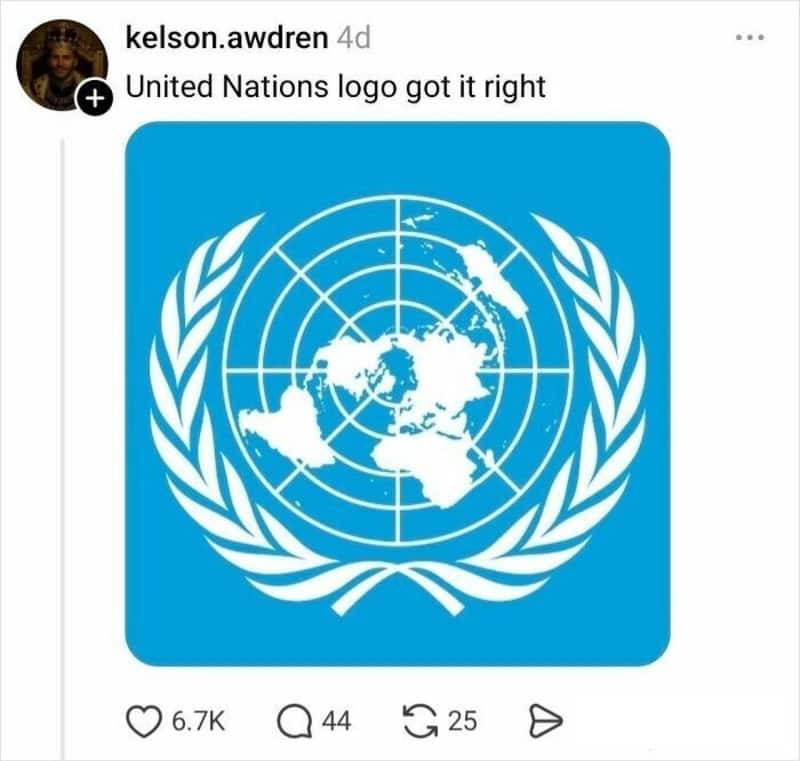
A pro-UN post from @kelson.awdren in the funny twitter thread about maps. The user shares the United Nations logo—which uses an azimuthal equidistant projection centered on the North Pole—and declares that they "got it right" by avoiding Mercator's rectangular bias.
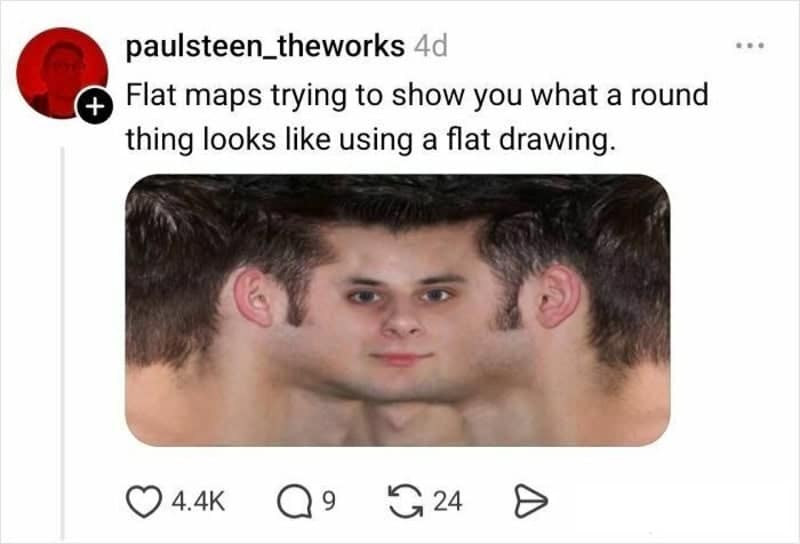
A "cursed" visual analogy from @paulsteen_theworks. The image shows a man's face flattened into a 2D rectangular texture map—nose in the center, ears on the far left and right—to mock how flat maps try to represent 3D spheres.

The first reason this thread is so good is the perfect blend of helpful and chaotic. People genuinely try to explain the problem—how you can’t flatten a sphere without distortion—but they do it with the internet’s favorite teaching style: a visual analogy so cursed you remember it forever. That’s peak map projection content, because once you see a “this is what flattening looks like” example, your brain never goes back to the classroom wall version.

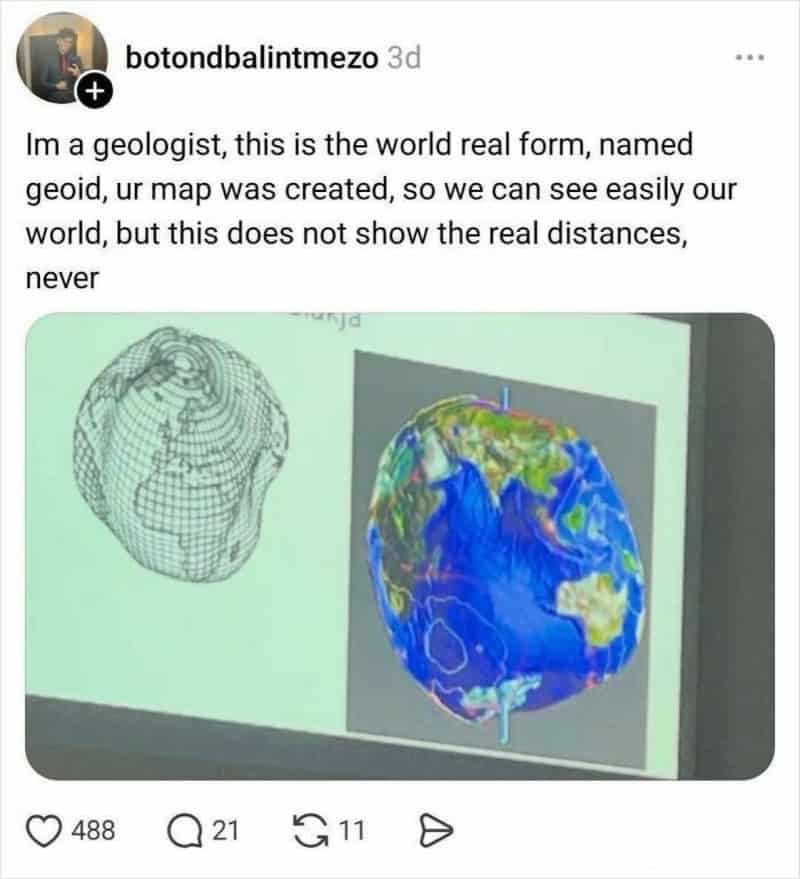
Then there’s the collective “wait… so the maps were lying?” moment, which is honestly a rite of passage. A lot of us grew up staring at the Mercator projection and absorbing its vibes without realizing it exaggerates landmasses near the poles. The thread turns that realization into comedy, and the jokes land because the surprise is real. Geography jokes hit hardest when they’re built on that little spark of learning—like a meme that also rewires your sense of scale.

The third theme is the tone of the replies: equal parts professor and group chat menace. Some people summarize it in the simplest possible terms, others arrive with full cartography receipts, and a few choose pure sarcasm as their teaching method. It’s a reminder that the internet can be a genuinely good classroom… as long as you’re okay with getting lightly cooked while you learn.

And when it’s done, you’re left with two things: respect for map projection facts, and the urge to drag outlines around a “true size” tool for the rest of the night like it’s a new hobby. That’s how you know a thread is elite.

If you want more “I learned something against my will” energy, go for 40 Interesting Maps That Will Change How You See The World, 30 Geography Memes That Sound Fake But Aren’t, and 30 Data Visualizations That Made Me Stop Scrolling.

I’m Katie Rodriguez, and I love when the internet teaches a real lesson while still being hilarious about it—because apparently that’s the only way my brain fully commits.

Katie Rodriguez is a seasoned writer with eight years dedicated to meme commentary, viral internet events, and digital storytelling. Formerly a senior meme analyst at Bored Panda and an occasional guest contributor at Vice's Motherboard, Kat specializes in meme culture’s intersection with social media phenomena—covering trends like Milk Crate Challenge, Area 51 Raid, and Baby Yoda. She’s known for her witty writing style and deep understanding of why certain memes resonate across generations, making her a valuable voice on Thunder Dungeon.
Read Memes
Get Paid

The only newsletter that pays you to read it.

A daily recap of the trending memes and every week one of our subscribers gets paid. It’s that easy and it could be you.