25 Companies That Made the Worst Business Decisions Ever

Roy

1 year ago

Worst business decisions ever

The road to business success is paved with both brilliant decisions and colossal blunders. This collection dives into the hall of shame of corporate history, showcasing 25 companies that made decisions so mind-bogglingly bad, they'll leave you shaking your head in disbelief (and wondering what they were thinking). From industry giants to smaller startups, no company is immune to a strategic misstep. So, buckle up and get ready for a cringe-worthy journey through the worst business decisions ever made.

This post is a treasure trove of cautionary tales for aspiring entrepreneurs (and anyone who enjoys a good dose of schadenfreude). Prepare to revisit infamous decisions like Yahoo's refusal to buy Google for a measly sum, or Blockbuster's baffling rejection of Netflix, ultimately leading to their own demise. The photos will also feature companies that alienated their customer base with bizarre marketing campaigns or product launches so poorly conceived, they defy explanation.

In 1998 Yahoo refused to buy Google for $1 million. In 2002 Yahoo offered to buy Google for $3 billion, but Google wanted $5 billion. Yahoo refused the offer. In 2006 Yahoo was to buy Facebook for $1.1 billion, but Yahoo's Ceo lowered it to $800 million and Facebook backed out. In 2008 Microsoft offered to buy Yahoo for $44.6 billion, but Yahoo refused. In 2016 Verizon bought Yahoo for $4.6 billion.
There was a donut shop by my high school. Opened at 6am and closed at 5pm so students would be there every day before school started at 7:30 and after school ended at 2:15. They changed their hours to 8am-3pm and couldn't make anymore money. They shut down a few months after the change.
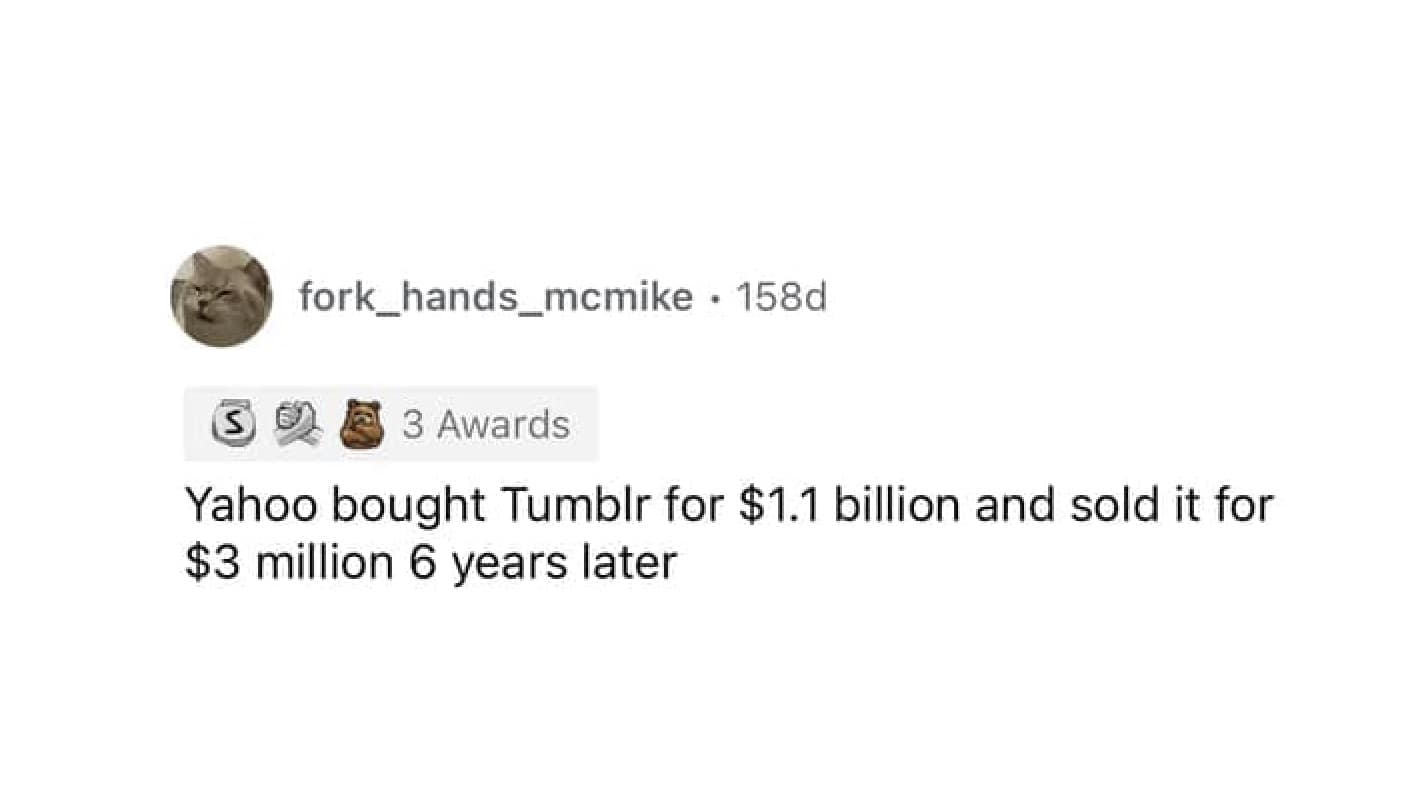
Yahoo bought Tumblr for $1.1 billion and sold it for $3 million 6 years later
One time Red Lobster offered an unlimited king crab leg deal, cause they brought the servings out slowly and were like 'nobody is gonna sit there for 6 hours and just eat king crab legs'. Actually, lots of people did. So many they lost millions.
Sears ended their catalog/mail order business in 1993. For over 100 years they had sold everything from hubcaps to houses via mail order and shipped them all over the country. Amazon was founded in 1994.
Quiznos. Corporate office decided to buy the vendors, and then contract all of the franchises to only buy materials from Corporate with a price hike. The margins got way too high and all of the stores went out of business. They shot themselves straight in the foot.
Kodak completely went under when they chose not to adopt digital photography. They eventually came back several years later, somehow.
not a company, but a country. the Northern ireland renewable heat incentive. basically they came up with the bright idea of encouraging people to use renewable power by paying people to do so. except you got more back per unit than the cost per unit. so people would buy an electric heater, put it on 24/7, get the money, use the extra money to buy another heater, plug that in for 24/7, get more money, buy another heater and so on. £500 million later they realised it wasnt such a good idea, the government collapsed and didnt reform again for 3 years.
Netflix almost did as they made the transition from dvds. They had a period where they dropped to dangerously low subscriber
JCPenney tried to stop bullshitting customers and it backfired. They said no more sales, they're just going to price everything low, because pretty much all sales at department stores are lies anyway. You're not really getting 70% off, the retail price was deliberately set stupid high to convince you it was a great deal. But the discount price is the actual value of it. So yeah JCPenney's heart was in the right place but ultimately it failed because customers are really that dumb and would rather be lied to.
This reminds me of A&W Who created the 1/3 pounder Focus groups and Market research shown the meat was better than McDonald's 1/4 pounder As in like 99.99% of people preferred its taste over the McDonald's burger It tasted better and it was in many cases cheaper and if not cheaper it was the same price as McDonald's And it bombed massively When they tried to find out why it was discovered the American people thought they were being cheated because 3 is a smaller number than 4 A&W realising they can't explain grade school fractions to fully grown adults without
In 2012, after a three-year hiatus in the sport, F1 team Lotus signed driver Kimi Raikonnen for the 2012 season. His contract included a clause that stated that Raikonnen would earn 50,000 euros for every point he scored in the two seasons of his contract. Raikonnen then went on to finish third in the 2012 championship, and 5th in the 2013 season, which was exceptionally impressive for Lotus. In doing this, he got 390 points in two seasons, and Lotus had to pay him 50,000 euros for each point, so he earned 19.5 million euros off of that bonus alone, which lead to Lotus almost filing for bankruptcy.

You've just embarked on a rollercoaster ride through the world's worst business decisions. You've cringed at the sheer audacity of some choices, chuckled at the absurdity of others, and secretly thanked your lucky stars you're not responsible for such epic fails. The post served as a potent reminder that even the biggest companies can make boneheaded decisions, and that sometimes, the road to success is paved with learning from the spectacular failures of others.

Feeling inspired to make brilliant business decisions (hopefully)? Our collection of "entrepreneurial life hacks" might be helpful. Need a break from the corporate world? Check out our gallery of "hilarious customer service fails" memes. Or, for a dose of heartwarming content, our collection of "small businesses crushing it" stories will leave you feeling optimistic.

Roy

Roy R., Chief Meme Curator Roy founded Thunder Dungeon in 2012 and has since guided its growth into a 2.5 million‑strong community of meme enthusiasts. With over a decade of digital‑media experience and a nose for viral humor, Roy oversees content strategy, ensuring every post is both hilarious and high‑quality

Read Memes

Get Paid

The only newsletter that pays you to read it.

A daily recap of the trending memes and every week one of our subscribers gets paid. It’s that easy and it could be you.